
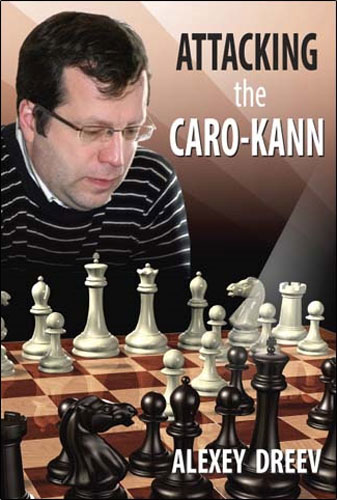
Attacking the Caro-Kann av GM Alexei Dreev
290 SEK
- Betala säkert med kort
- Maila oss, vi svarar snabbt!
- 30 dagars öppet köp
Saknar du en artikelgrupp? Kontakta oss och berätta!
Beskrivning
Art.nr: 9786197188042
av GM Dreev, 2015, 235 sidor
Dreev har spelat framskjutningsvarianten (1.e4 c6 2.d4 d5 3.e5) mot Caro-Kann under många år. Den är enkel att spela för vit. Det är svart som har de största problemen att lösa. Han vill spela c6-c5, men kan man verkligen spela först c7-c6 och sedan c6-c5 ostraffat? Han vill också spela ut löpare till f5 innan han spelar e6. Att göra bägge dessa (c6-c5 och Lf5) kostar tid och ger vit möjlighet att ta kommendot på kungsflygeln. Vill du vinna mer mot Caro-Kann kan vi rekommendera att du lär om och lär nytt!
Framskjutningsvarianten i Caro-Kann (1.e4 c6 2.d4 d5 3.e5) blev intressant för teoretikerna efter VM-matchen 1961 mellan Mikhail Tal och Mikhail Botvinnik. Några tyckte att vit nästan slösar ett drag med 3.e4-e5, men detta drag som sluter centrum ger svart utrymmesbrist i centrum. Om allt går enligt plan kan vit långsamt expandera på kungsflygeln. Sedan många år tillbaka ses framskjutningsvarianten som ett fullvärdigt alternativ till den klassiska varianten efter 3.Sc3 dxe4 4.Sxe4. Idag ses det nog som vits huvudvapen mot Caro-Kann. Eftersom var och varannan i världstoppen spelar Framskjutnings mot Caro-Kann så händer det mycket på det teoretiska planet. Många till synes harmlösa drag har visat sig sätta svart under obehaglig press. Det bästa av allt är att allt ännu inte är utforskat här. Det finns fortfarande rum att prova lite egna idéer. Man kan spela lite mer man mot man än i den klassiska varianten eftersom man där behöver kunna lite drygt 20 drag ifall man vill utmana den mest påläste.
Dreev själv säger att hans erfarenhet i varianten är att det är väldigt svårt för svart att lösa alla problem och få ett komfortabelt spel och att man ofta hamnar i ställningar där man måste tänka själv. Han rekommenderar varianten för spelare som gillar postionellt komplicerade fighter där standardlösningar inte funkar. Vitspelaren bör vara beredd att ta initiativet och sedan behålla skickligt behålla det.
Om författaren:
Alexey Dreev is one of the most popular contemporary Russian grandmasters.
He was twice World junior champion (under 16) in 1983 and 1984, silver medalist under 20 in 1984, European champion under 20 in 1988.
Dreev is the winner of many international tournaments.
With the Russian team, he was three times Olympic gold medalist and once he got the silver, he also won two times the World team championship - in 1997 and 2005.
He was the European champion for 2012 in rapid chess.
Baksidestext på engelska:
The Advance Variation of the Caro-Kann Defence (1.e4 c6 2.d4 d5 3.e5) attracted for the first time the attention of the chess theoreticians during the World Championship match between Mikhail Tal and Mikhail Botvinnik back in the year 1961.
White seems to lose a tempo for the move 3.e5, but closes the centre in this way, providing himself with a considerable space advantage and impeding the harmonious development of Black's kingside.
The Advance Variation of the Caro-Kann Defence is a very good alternative to the Classical Variation 1.e4 c6 2.d4 d5 3.Nd2 (or 3.Nc3) dxe4 4.Nxe4 Bf5 (4...Nd7).
The theory after 3.e5 has developed extensively nowadays too; nevertheless, the positions of the Advance Variation are considerably less studied than those in the classical lines, in which there is much less practical fight and much more a comparison of thorough theoretical erudition.
"My long-term experience in playing the Caro-Kann Defence with Black has shown to me that his problems in this variation are not easy to solve at all.
The variation we analyse in this book often leads to non-standard situations on the board, so I would recommend it to players who are inclined to enter complicated and unusual positions and who hope to seize the initiative and to maintain it skilfully." - writes Dreev.
Alexey Dreev is one of the most popular contemporary Russian grandmasters.
He was twice World junior champion (under 16) in 1983 and 1984, silver medalist under 20 in 1984, European champion under 20 in 1988.
Dreev is the winner of many international tournaments.
With the Russian team, he was three times Olympic gold medalist and once he got the silver, he also won two times the World team championship - in 1997 and 2005.
He was the European champion for 2012 in rapid chess.
Filer och media
 | Bifogad fil |