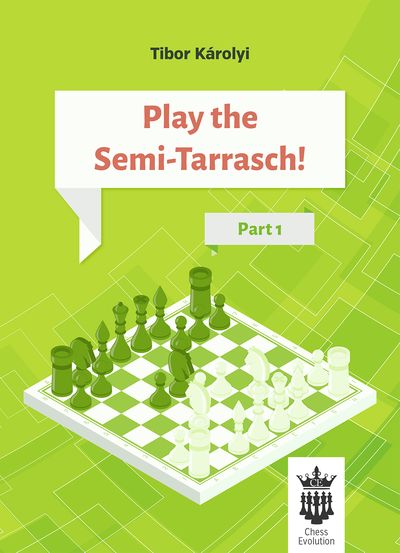
Play the Semi- Tarrasch! part 1 av Tibor Karolyi
270 SEK
- Betala säkert med kort
- Maila oss, vi svarar snabbt!
- 30 dagars öppet köp
Saknar du en artikelgrupp? Kontakta oss och berätta!
Beskrivning
Art.nr: 9786155793035
Play the Semi-Tarrasch! - Part 1
Publisher: Chess Evolution, 2018, Pages: 224, Paperback
According to my database, after 1.d4 d5 2.f3 f6 3.c4 e6 4. c3 c5 5.cxd5 it was the Swiss player Hans Fahrni who was the first to recapture with the knight. It happened in 1905 and, although he drew against Ossip Bernstein, Fahrni never repeated it. One year later, his play was followed by the first world-class player, Carl Schlechter. The opening became regularly played only in the thirties. Alekhine as White faced it in 1931, and he impressively beat Grünfeld. One year later he decided to give it a try with Black. So, the first time a world champion employed it. Alekhine would go on to use it five more times in regular tournament games. He played it in one of his most famous games, although sadly for him he lost against the rising star Botvinnik. Other world champions, such as Lasker and Euwe, also started to use it. In 1959, Fischer played it and drew with two strong opponents, Robert Byrne and Samuel Reshevsky. Tal started to play it one year later; he became a regular Semi-Tarrasch Player. Botvinnik, Spassky and Petrosian joined the club in the sixties. Kramnik plays it a lot, while Carlsen rarely employs it. So it means that except for Smyslov, Karpov, Kasparov and Topalov, all the world champions at least gave it a try. And in the past many of the all-time great players played it, some of them quite oft en.
Let me name a few top players (apart from the champions I already mentioned) Who have employed it in recent years: Nakamura, Giri, Karjakin, Ding Liren, Harikrishna, Naiditsch, Bu, Wang Yue and the young Wei Yi. In the eighties and the nineties it was not popular, but perhaps because other openings lost some of their attractiveness, people turned their attention back to this old weapon. Black in many lines gives up some space, but has no weakness. The pawn structure is not symmetrical and that means that some tension may remain. Yes, the opening is rarely dynamic and rarely results in great complications, but there is a good chance that he fight will last longer. It may make players not use their computers so efficiently during their preparation. Also, unlike in many openings, if one doesn’t remember his or her preparation and makes the second or the third best move, the position is highly unlikely to collapse and the opponent still has to outplay you.
Tibor Károlyi
Filer och media
 | Bifogad fil |