
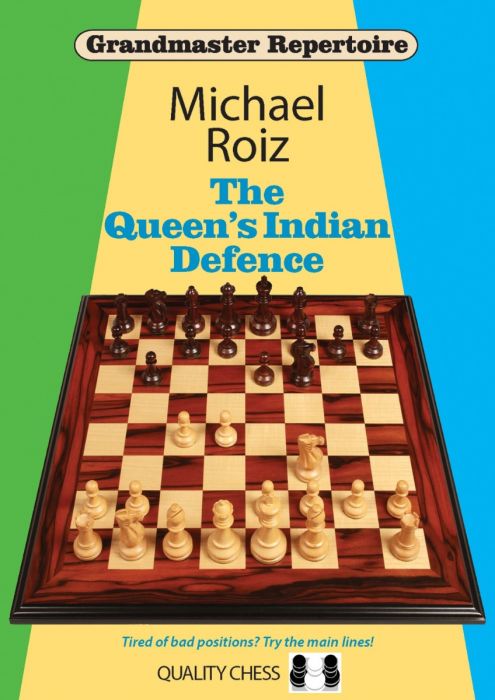
Grandmaster Repertoire: The Queens Indian Defence - Hårdpärm
390 SEK
- Betala säkert med kort
- Maila oss, vi svarar snabbt!
- 30 dagars öppet köp
Saknar du en artikelgrupp? Kontakta oss och berätta!
Beskrivning
Art.nr: 2275
av Michael Roiz
2018, 424 sidor
Från bokens baksida:
The Queen’s Indian Defence is one of the most reliable defences against 1.d4, and features in the repertoires of many of the world’s top players. Black develops with a solid pawn structure and uses his pieces to put dynamic pressure on White’s pawn centre. GM Michael Roiz supplies an elite repertoire built upon sound positional principles, offering active piece play and a fight for the initiative.
In this companion volume to the author’s highly-regarded The Nimzo-Indian Defence, the starting point is 1.d4 Nf6 2.c4 e6. The main focus is on 3.Nf3 b6 while Roiz also covers 3.g3 (Catalan) and miscellaneous options.
Grandmaster Michael Roiz reached the top 40 in the world. He has won Olympiad Team Silver for Israel, as well as many tournaments over the years. In recent years he has focused more on seconding elite grandmasters in top tournaments such as the Candidates and so far one World Championship match.
Från förordet (läsvärt)
Following the success of my previous book Grandmaster Repertoire – The Nimzo-Indian Defence,
I was delighted when Jacob Aagaard and John Shaw offered me the opportunity to write a
companion volume covering the Queen’s Indian and Catalan from Black’s perspective, making
for a complete repertoire after 1.d4 ¤f6 2.c4 e6. As a long-time 1.d4 player, I have used a variety
of weapons against the Queen’s Indian and have also incorporated it into my Black repertoire.
Despite all this experience in my playing career, I could never have imagined how strategically
rich this opening is, until I analysed it for this book. Even though the Queen’s Indian has a
reputation for solidity, certain variations can lead to extremely sharp, double-edged play.
I believe the Queen’s Indian and Nimzo-Indian combine perfectly, since Black’s strategic goals are
similar in both openings: he develops quickly and aims to control the centre with pieces initially,
while keeping a flexible pawn structure. In this book we will encounter a few lines where an early
¤c3 allows Black to transpose to a pleasant version of a Nimzo-Indian with ...¥b4. Moreover, I
have endeavoured to make our complete repertoire as compact as possible, which is one reason
why I opted to meet 3.g3 with 3...¥b4†, after which 4.¤c3 would lead straight to Chapter 7 of
my Nimzo-Indian book.
Apart from making the repertoire theoretically robust and sharing numerous theoretical novelties,
one of my main goals in this book has been to share my knowledge of certain thematic pawn
structures such as hanging pawns, isolated d5-pawn, Hedgehog structure and more. It is worth
mentioning that it is mostly Black who gets to choose which structure to enter, and the correct
decision will depend on how well his pieces will coordinate in the resultant positions, as well as
taking into account the opponent’s set-up. For instance, after 4.g3 ¥a6 5.¤bd2 White’s ability to
exert pressure on the centre is limited, so 5...d5 becomes more appealing. If, on the other hand,
White goes for some other 5th-move option which enables his knight to go to the more active
c3-square, then I would refrain from fixing Black’s central structure so soon.
The Queen’s Indian is justifiably popular at all levels and has proven its reliability even in World
Championship matches. I hope the readers will enjoy this book and find many useful things for
their chess education.
Filer och media
 | Läs ett utdrag ur boken! |