
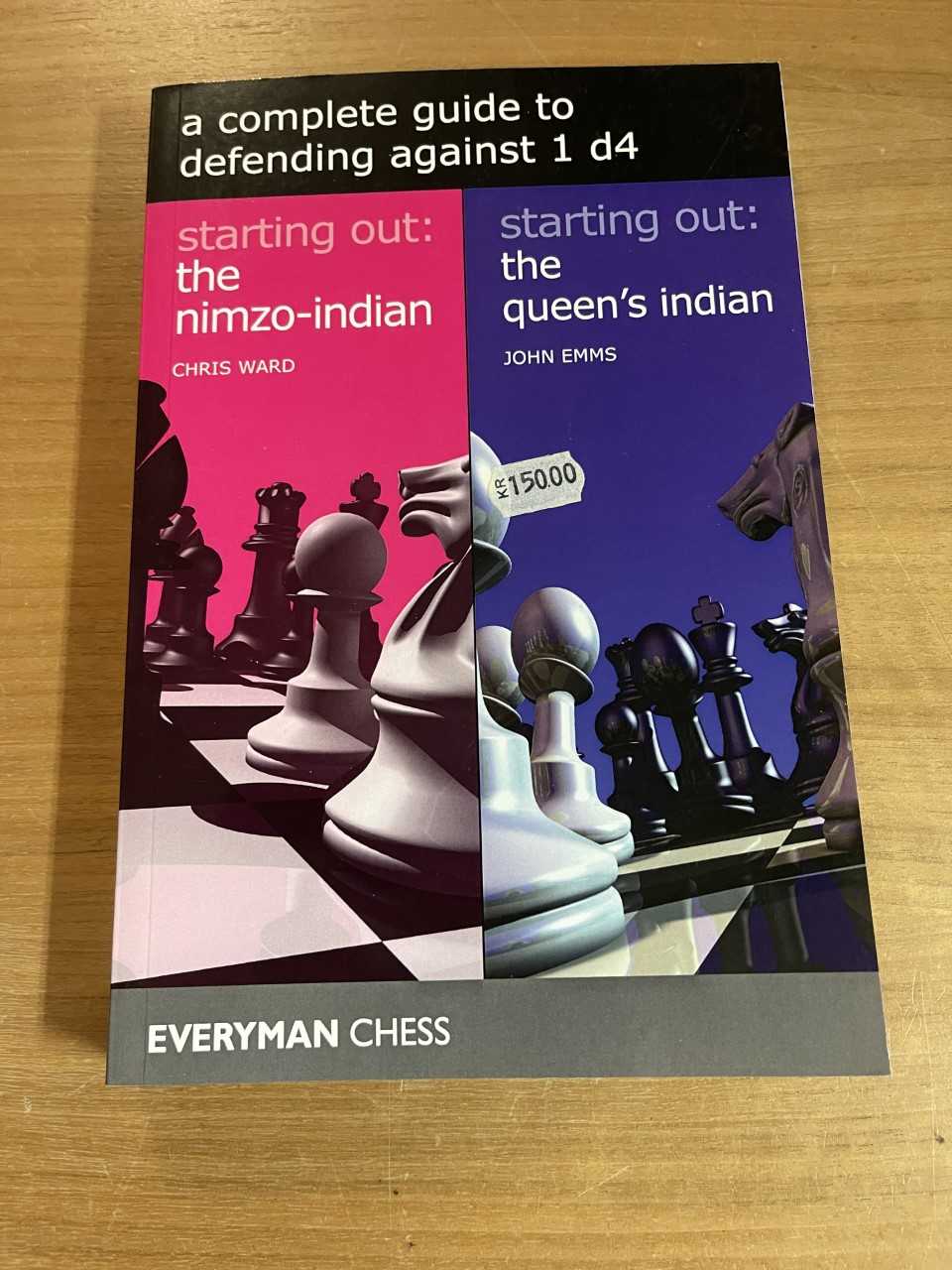
Antikvariskt - a complete guide to defending against 1.d4 av Chris Ward och John Emms
150 SEK
Mycket gott skick
Two great books from the Everyman Chess Library, Starting Out: The Nimzo Indian by Chris Ward and Starting Out: The Queen’s Indian by John Emms, brought together in one volume.
- Betala säkert med kort
- Maila oss, vi svarar snabbt!
- 30 dagars öppet köp
Saknar du en artikelgrupp? Kontakta oss och berätta!
Beskrivning
Art.nr: 4135
Starting out: the Nimzo Indian
Den tredje boken i "Starting-out-serien" om olika spelöppningar handlar om Nimzoindiskt (1.d4 Sf6 2.c4 e6 3.Sc3 Lb4).
Chris Ward går fram i maklig takt. Han tar en bivariant i taget och förklarar planer och idéer; han påpekar vad som är viktigt, ger tips och varnar. Varje kapitel inleds med en idéöversikt, sedan följer den viktigaste varianten (dvs lite teori), och det hela avslutas med några illustrativa partier. Det är lätt att följa. Merparten av partierna är spelade år 2000 eller senare, många av författaren själv, med båda färger! Boken är en nybörjarbok, och vi hoppas att läsarna hör av sig med betyg. Det första intrycket verkar bra tack vare att merparten av förklaringarna är verbala. Från 1100-1800.
Two great books from the Everyman Chess Library, Starting Out: The Nimzo Indian by Chris Ward and Starting Out: The Queen’s Indian by John Emms, brought together in one volume.
The Nimzo-Indian is one of the soundest and most popular defences against 1 d4, offering Black the chance to unbalance the game early on and play for a win without undue risk. Advocates include virtually all of the world's top players, including Garry Kasparov, Vladimir Kramnik, Vishy Anand and Anatoly Karpov. In this revolutionary book, Grandmaster Chris Ward revisits the basic principles behind the Nimzo-Indian and its many variations. Throughout this easy-to-read guide the reader is helped along by a wealth of notes, tips and warnings from the author, while key strategies, ideas and tactics for both sides are clearly illustrated. This book is ideal for the improving player.
The Queens Indian is one of Black’s most dependable and respected defences to the queen's pawn opening. It is an established favourite amongst world-class Grandmasters such as Vladimir Kramnik, Vishy Anand, Michael Adams and Judit Polgar, not to mention Anatoly Karpov, who has been a loyal Queens Indian supporter and theory developer for over three decades. Rather than classically occupying the central squares with pawns, Black adopts a hypermodern approach and endeavours to control this key area with pieces. This procedure leads to rich and varied positions that will appeal to players who like complex play. In this easy-to-read guide, Grandmaster and Queens Indian expert John Emms goes back to basics, studying the essential principles of the Queens Indian and its numerous variations. Throughout the book there are an abundance of notes, tips and warnings to guide the improving player, while key strategies, ideas and tactics for both sides are clearly illustrated.