
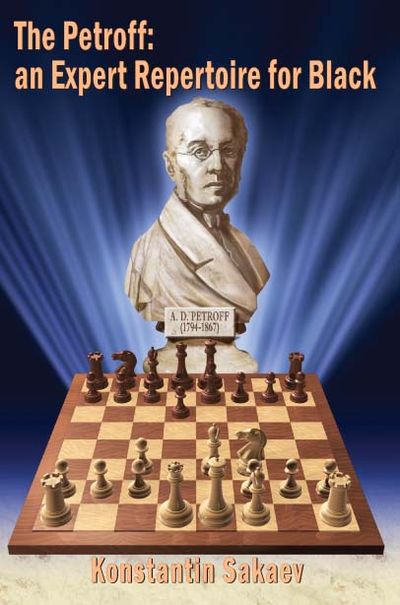
The Petroff: An Expert Repertoire for Black (GM Sakaev)
240,01 SEK
- Betala säkert med kort
- Maila oss, vi svarar snabbt!
- 30 dagars öppet köp
Saknar du en artikelgrupp? Kontakta oss och berätta!
Beskrivning
Art.nr: 9789548782845
av GM Sakaev
2011, 292 sidor
Ryskt är en pålitlig öppning. Man kommer aldrig dåligt som svart. Många vitspelare tar stora risker och riskerar då att bli fullständigt utspelade av positionellt starka spelare. Sakaev ger dig en komplett repertoar mot 1.e4, han förklarar alla nyanser och subtiliteter så att du förstår dem. Han behandlar de kritiska ställningarna extra noga och ger förslag på nya drag.
In this book the reader will find an opening repertoire for Black against 1. e4, based on the Petroff Defence and designed to be used up to the highest level. For many years this opening has served as the main black weapon for chess giants as Vladimir Kramnik and Boris Gelfand.
The Petroff Defence is especially suitable for positionally-oriented players who like to obtain a solid and reliable game after the opening. The theoretical material in the book has been thoroughly prepared and systematized. The many new ideas and novelties have all been explained in a way designed to make it easier for the reader to understand and employ them in his own games.
PREFACE
The Petroff Defence is an exceptionally reliable and almost indestructible
opening, and a hard nut to crack, even for the strongest and most
meticulously prepared grandmasters theoretically. It is no accident
that the Petroff Defence, named after its inventor and also know as the
Russian Game, has for many years been the main opening weapon of
Vladimir Kramnik and Boris Gelfand and has also been played regularly
by Vishy Anand and Alexey Shirov. Nowadays there are also several
very young and talented grandmasters who play it, such as Wesley So
and Anish Giri. Anatoly Karpov and Artur Yusupov have been using
it as a part of their opening armoury throughout their chess careers...
The list could go on and on.
The Petroff Defence is characterised by the fact that on his second
move Black does not protect his e5-pawn, but instead counter attacks
with 2...Nf6, proposing to the opponent the immediate exchange of a
pair of pawns, thus slightly simplifying the position and quickly defining
the future pawn-structure.
What are the pluses and minuses of an opening repertoire based on
the Petroff Defence, such as we are recommending in this book? I think
I can see only one drawback. If White is an experienced player with a
good grasp of theory, and he is in the mood to draw, then he should be
able to share the point without too much problem. Still, the same can
also be said about almost every other opening, because in contemporary
chess it is tremendously difficult to win with Black unless White
makes a serious mistake. On the other hand, there is a great advantage
to consider: you will not obtain bad positions from the opening. The
Petroff Defence is particularly suitable for players with a positional
style, since in a calm, quiet contest you can easily win the game if the
opponent takes too many risks. You can see this illustrated in the Complete
Games section.
I have endeavoured to present and explain to you all the finer points
of this opening, as I understand them. In general, the critical positions
have been treated thoroughly and I have also suggested and analyzed
a great many new ideas in this book. Some variations which have
amassed considerable tournament practice, but which, in my view, are
8
less principled, have been covered only briefly. Otherwise, the book
would have become too big, losing its essential purpose. Unfortunately,
too many authors write chess books in that way; they offer no original
analysis and often quote outdated games, some of which are very
weakly played and almost useless.
I hope that you, the reader, will enjoy studying this book, and I wish
you wonderful tournament results with this opening!
Konstantin Sakaev,
Saint Petersburg 2011
Filer och media
 | klicka här för ett utdrag ur boken |
| Bifogad fil |