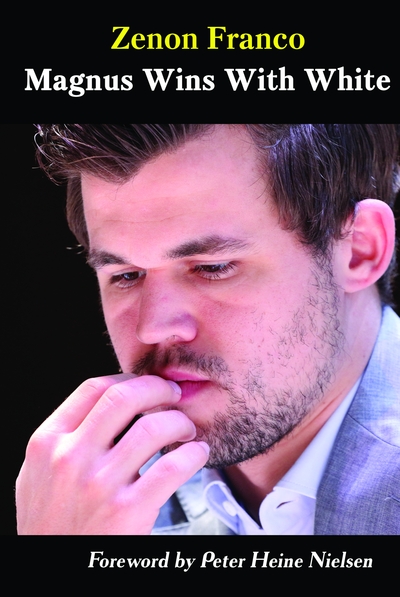
Magnus Wins With White
230 SEK
Här nedan kan du läsa Peter Heine Nielsens fins förord i boken:
Perhaps, yet by the age of 29 Magnus has created so many interesting games of chess that there is plenty material for not just one book, but two! It does in some way feel early to define any kind of “status”, as hopefully titles are still to come, brilliances to be won and playing style to evolve. It is very much work in progress, even if “work” feels the wrong way to describe Magnus’s attitude to chess, which is very much better defined by passion and curiosity. 2019 was the year of AlphaZero, with Magnus playing h4! at any reasonable moment, while 2020, the year of this book’s publishing, has just included a brilliant win vs. Giri with an early g4!
Magnus Carlsen (2863) - Anish Giri (2764) [D38]
Legends of Chess chess24.com INT (1.2), 21.07.2020
1.d4 Sf6 2.c4 e6 3.Sf3 d5 4.Sc3 Lb4 5.Lg5 h6 6.Ld2 0-0 7.g4 Lxc3 8.Lxc3 Se4 9.Dc2 c5 10.dxc5 b6 11.g5 hxg5 12.h4 g4 13.Sg5 f5 14.Lg2 bxc5 15.0-0-0 Sxg5 16.hxg5 Dxg5+ 17.Kb1 Sd7 18.cxd5 Sb6 19.dxe6 Lxe6 20.Lxa8 Txa8 21.Dd2 Dg6 22.Dd6 f4+ 23.Ka1 Tf8 24.De5 g3 25.fxg3 Sc4 26.Dh5 Dxh5 27.Txh5 Se3 28.Tg1 Lf5 29.b3 fxg3 30.Txg3 Lg4 31.Txc5 Tf1+ 32.Kb2 Sd1+ 33.Ka3 Sxc3 34.Txg4 1-0
In 2017 it was 1 f4!? vs. Kramnik. Seemingly, any pawn, or any strategy,
will do at the right time! Magnus is connected both to cutting edge artificial intelligence, and to the psychology of Lasker a century back. Having grown up as part of the “internet generation”, Magnus has gotten an enormous amount of experience by playing thousands of games at fast time controls online, yet has also made a careful study of the classics, often referring to them. Defining him is as difficult as facing him at the board. You just can’t know for sure what to expect. A tenacious 7 hour grind, or a blitz attack on your king? Bad luck for the opponents, but good luck for the reader of this book! It will take you to all corners of chess styles, as Magnus universally masters them all. Zenon does a great job of explaining Magnus’s moves in a human manner. Especially fitting in the sense that the champion himself often repeats the necessity to understand a chess position from a human perspective, not just as numeric output from an engine.
Defining the book is somewhat complicated. Obviously, it is a games
collection, but it is not really a biography in the sense that tournament details, anecdotes etc., are omitted, and the focus is chess! If anything, I would say it is something as rare as a book about the middlegame explained via Carlsen’s games. The format has an interesting twist. The reader will have to pause, think for himself and try to “guess” Carlsen’s next move before moving on and seeing the explanations.
Bent Larsen, historically the strongest Scandinavian chess player till the
appearance of Carlsen, published a series of booklets in the 1970s called Bent Larsen’s Skakskole. Some of the books were designed exactly according to this concept, called Find the Master’s Move. Another book in the series was Find the Plan, later to become Magnus’s first chess book containing 50 exercises to find the right middlegame plan. Larsen’s teaching style was to expose the reader to knowledge, not necessarily grouped thematically, but in that way perhaps representing reality better. And should one choose to read this book not only as entertainment and for pleasure, of which there is a lot, but also in the hope of improving one’s games, the material is there. Excellent chess moves from the best player in the world and perhaps in history, explained in a simple and instructive manner for everybody to understand. Have fun!
Grandmaster Peter Heine Nielsen,
Chief Second and Coach to Magnus Carlsen
- Betala säkert med kort
- Maila oss, vi svarar snabbt!
- 30 dagars öppet köp
Saknar du en artikelgrupp? Kontakta oss och berätta!
Beskrivning
Art.nr: 2678
In Magnus Wins With White Grandmaster Zenon Franco deeply analyses 32 of Magnus Carlsen’s most instructive games where he wins with the white pieces. This book is written in “move by move” style, a good training tool containing exercises and tests. This format is a great platform for studying chess, improving both skills and knowledge, as the reader is continually challenged to find the best moves and the author provides answers to probing questions throughout.
Most of the games are taken from Magnus’s recent career, including one from 2020 and eight from 2019. His opponents are nearly all super-grandmasters, and they include former world champions Viswanathan Anand and Vladimir Kramnik, as well as Wesley So, Maxime Vachier-Lagrave, Alexander Grischuk, Levon Aronian, Boris Gelfand, and, naturally, Anish Giri. In the majority of these games, Magnus demonstrates his ability to outplay his opponents in the middlegame by simply making stronger moves and applying constant pressure that eventually forces the opponent to crack and play weaker moves. In some games, however, this takes place in the endgame. A second book, Magnus Wins With Black, is forthcoming.
With a foreword by Magnus Carlsen's Chief Second and Coach Peter Heine Nielsen
Filer och media
 | Bifogad fil |