
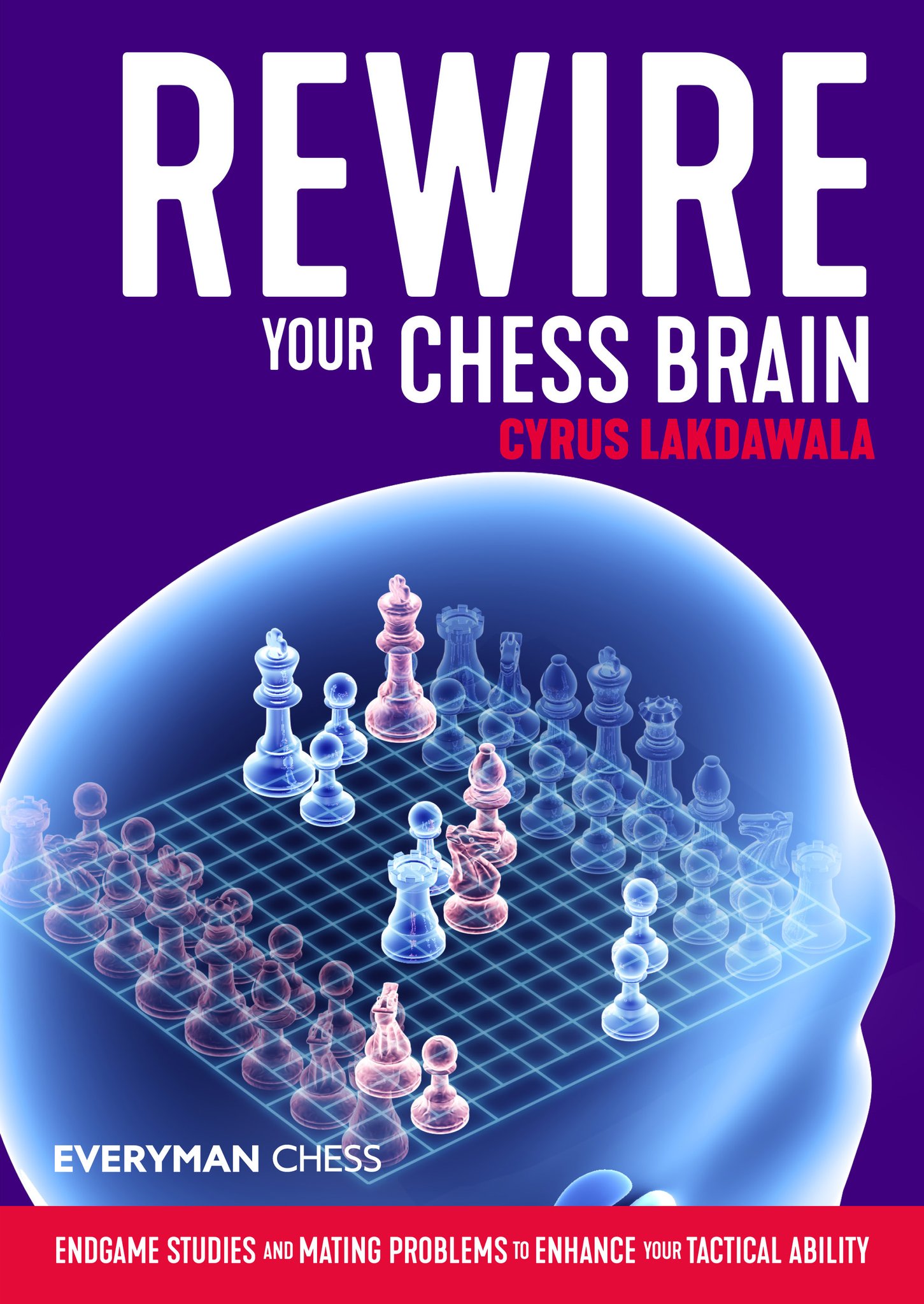
Rewire Your Chess Brain: Endgame studies and mating problems to enhance your tactical ability
390 SEK
av IM Lakdawala, 2020, 528 sidor
En bok med problem och studier.
- Betala säkert med kort
- Maila oss, vi svarar snabbt!
- 30 dagars öppet köp
Saknar du en artikelgrupp? Kontakta oss och berätta!
Beskrivning
Art.nr: 2709
Rewire Your Chess Brain is not your average chess book. It does not deal with opening theory or middlegame strategy. It focuses purely on problems and studies, all of which are the results of artificial construction rather than scenes from real-life battles.
In a chess study, White has to play and win (or draw). In a chess puzzle, White has to force mate in a stipulated number of moves. The starting positions in both forms rarely resemble anything found over the board in real life play. However, the solutions are invariably surprising and often quite beautiful. The best examples of both forms have often been compared to great works of art.
However, these are not mere gallery pieces, lacking practical application in real life play. Solving these puzzles can be extremely challenging and will, without question, improve the “real world” tactical ability of anyone attempting to do so.
Prolific chess author and coach Cyrus Lakdawala has been intrigued by studies and problems all his life. When training his students he often sets them studies and problems to solve. Many of them who have adopted this technique have seen extraordinary increases in their chess ratings. In this book Lakdawala assembles the problems and studies that are most effective to improve tactical ability. Work your way through this book and you will undoubtedly see the results in your own games.
If I had to compare what I do to some scientific discipline it would probably be archaeology. The beautiful moves, positions and ideas are waiting around to be found (or created, if you prefer to call yourself an artist). The most skilful composer is the one who digs up the best artefacts. The world will then hopefully appreciate the beauty of his discoveries in due time. At times, the artefacts are of such an obvious shiny beauty that almost every chess player appreciates them (Saavedra, Réti's Kh8-g7). At other times the beauty is of such an abstract nature that hard work is required by the audience/solver. At those times the composer may feel very lonely, regretting his choice of career... --- To me, the moment of the actual discovery always brings the greatest joy. Recently I came across a position with K, R and P vs. K, R and P. Black has three defences to stop the white pawn and, after each of these, White sacs his rook in a different way and wins. --- I wonder why no one noticed this beautifully simple position before me? Obviously, composition is part addiction as well...
Filer och media
 | Läs ett utdrag! |