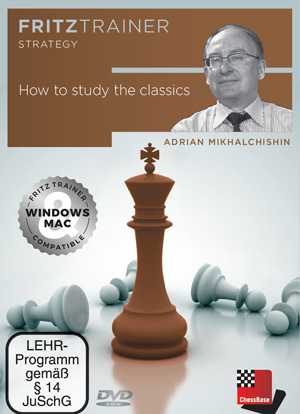
How to study the classics av Adrian Mikhalchichin
290 SEK
Chess education is based on examples of great players of the past. Most of the typical methods of attack, analogous plans and correct ways of conducting different endgames happened for the first time in their games. On the basis of these games, numerous books have been written about endgame subjects and endgame technique. Even concerning openings, the great Alexander Alekhine said that theory is simply the practice of the masters!
- Betala säkert med kort
- Maila oss, vi svarar snabbt!
- 30 dagars öppet köp
Saknar du en artikelgrupp? Kontakta oss och berätta!
Beskrivning
Art.nr: 3031
Naturally every developing player has to study these examples, as he will face similar positions and problems in his practice. The more a player knows of these positions, the more frequently he will be able to apply the necessary ideas in the correct way. Of course, there are many basic positions in endgames and precise variations in the openings, which have to be remembered by heart. But the greatest part of endgame and middlegame play consists of knowledge of typical plans and typical tactical motifs, which can be used for different purposes. To help you attack the opponent’s king or simply to help you implement plans faster and more effectively. Every young player has to study them and that is possible just from the games of the great players. Vladimir Kramnik once said that at the moment when he decided to fight for the World Championship, he spent one year just analysing all the matches of the WCh. In general, we have to study the classics in two ways: 1) As we explained, in the books on the endgame and the middlegame. Different important subjects are studied from the selected games of the greats. 2) Every top player had his or her own speciality. Like Rubinstein was the greatest master of the ‘exchange technique’, Botvinnik was master of ‘centralisation’ and Alekhine was the greatest player in developing an opening initiative. For each of them there are extraordinarily instructive examples in which they employed their own favourite methods. Another problem exists – in the chess world we don’t have many good books on the middlegame and for this reason young players have problems knowing how to study the classics. Different tactical methods do exist and for these subjects we have plenty of good literature. We will present a few examples showing how the same tactical methods were developed by the top players and how more complicated it became over the years. The same situation is true of the development of typical plans in classical structures.
• Video running time: More than 5 hours (English)
• With interactive training including video feedback
• Extra: Database with more Classics
Introduction
How to use the classics in your own games
Game 1: Mikhalshichin - Bronstein, 1980
Game 2: Olafsson - Fischer, 1958
Game 3: Mikhalchishin - Beliavsky, 1981
Game 4 and 5: Vidmar - Tarrasch, 1906 and Mikhalchishin - Lalic, 1985
Strategic handling of manoeuvres
Flank attack
Dynamic counter attack in classical openings
Sacrifice on e6 in the Sicilian
Sacrifice on b5 in the Sicilian
The rook transfer
Strategic handling of typical pawn structures
Attacking in the King's Indian
Preventive strategy in development
The knight on e5
Central strategy with a pawn on d5 Part 1
Central strategy with a pawn on d5 Part 2
Opening the centre in Maroczy structures Part 1
Opening the centre in Maroczy structures Part 2
Miscellaneous
Endings with the bishop pair
Changing the central structure Part 1
Changing the central structure Part 2
Changing the central structure Part 3
Changing the central structure Part 4
Changing the central structure Part 5
Exploitation of weak squares Part 1
Exploitation of weak squares Part 2
Modern Attack in the French Defence Part 1
Modern Attack in the French Defence Part 2
Exercises 1-10
Exercise 01
Exercise 02
Exercise 03
Exercise 04
Exercise 05
Exercise 06
Exercise 07
Exercise 08
Exercise 09
Exercise 10
Exercises 11-20
Exercise 11
Exercise 12
Exercise 13
Exercise 14
Exercise 15
Exercise 16
Exercise 17
Exercise 18
Exercise 19
Exercise 20
Exercises 21-31
Exercise 21
Exercise 22
Exercise 23
Exercise 24
Exercise 25
Exercise 26
Exercise 27
Exercise 28
Exercise 29
Exercise 30
Exercise 31
Bonus
Analysis
More Classics
Exercises